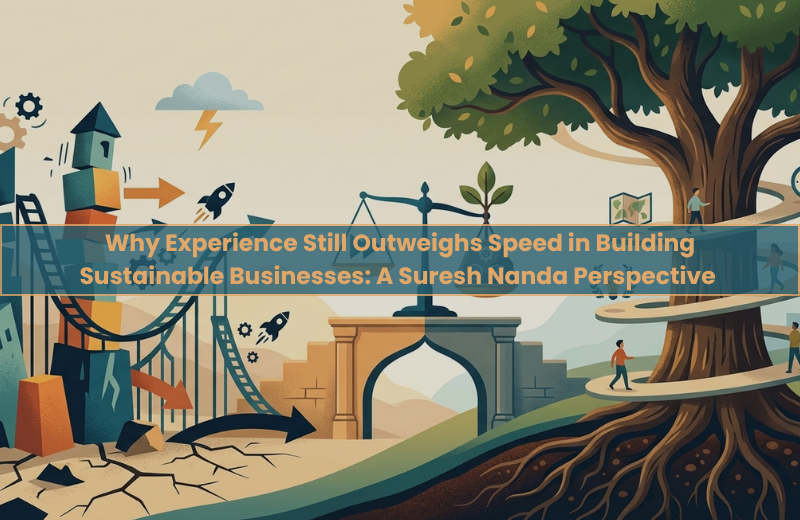
Rapid business growth is undoubtedly the biggest competitive advantage. Stakeholders also judge a company’s success by how quickly it was able to cross a breakthrough. However, global corporate models have consistently shown that rapid expansion doesn’t guarantee sustainability or the ability to deal with crises.
Suresh Nanda is one of the leading figures in multi-sector business. When we read Suresh Nanda news insights on various business topics here, one thing that remains constant is how experience always outweighs speed in the market.
Experience Builds Judgment, Not Just Knowledge
In business, experience never becomes obsolete; it becomes invaluable. One of the major outcomes of business experience is foundational to new-generation enterprises. Knowledge can be acquired through education and training, but judgment is developed through years of strategizing. One of the most prominent business leaders, Suresh Nanda, with more than 40 years of experience in global multi-enterprise sectors, brings deep, thoughtful insights.
In corporate strategy, judgment influences:
- expansion decisions,
- Investment strategies,
- Partnerships
Visionary business leaders focus on Long-term viability. So, before one can dilute brand value, weaken operational control, and create financial pressure.
The Risk in Rapid Growth of Business
Rapid growth looks impressive in numbers, but it carries multiple risks. Hitting a profit target isn’t usually the hard part. However, companies that scale rapidly encounter core problems that can undermine their future success and reputation. As reported by Suresh Nanda News, the issue for many of these swiftly expanding businesses isn’t a flawed business model. Instead, it’s that their growth outpaces their capacity to manage it.
Sustainable businesses are built by leaders who understand that growth and capability need to go hand in hand. Multiple factors support business expansion. Some of them include experienced leaders, trained personnel, financial stability, and brand positioning. Without these foundations, speed becomes a liability in the long run.
Role of leaders behind Sustainable Partnerships in Business
In many industries, especially hospitality, luxury services, and real estate, business success depends on the leader’s ability to build strategic partnerships. Suresh Nanda and other hospitality giants have demonstrated a fundamental truth: enduring clients, successful partnerships, and brand loyalty are cultivated over time, not in weeks. Experience has shown business leaders the value of relationship capital.
Experience teaches business leaders the importance of relationship capital. While technology and marketing attract customers through one-time interactions, strong collaborations enhance brand value.
Building a Brand Value Takes Time
The name of a brand is a kind of recognition that is established through the process of branding. It is not achieved rapidly or by spending heavily on advertising and marketing campaigns. A strong brand is built on the pillars of trust, quality, and consistency.
There is a notion for the hospitality sectors across the globe. Here, brand perception is directly linked to pricing power. For The Claridges (Owned by Suresh Nanda), people believe in the credibility. This trust is not created through rapid expansion or aggressive marketing alone. It’s mostly because of the foresight planning of Mr. Nanda.
Financial Discipline and Long-Term Survival
Another major difference between speed-driven and experience-driven businesses is backed by financial strategies. Suresh Nanda News insights suggest that fast-growing companies rely most on debt and credit funding. If such companies fail to meet the expectations of stakeholders, it can create major financial crises in unfavourable market cycles.
Experienced business leaders, however, often focus on balance sheet that is strong, controlled and offers financial stability. It’s also a fact that survival during difficult economic periods is more important than unplanned rapid expansion during good times. Hence, Businesses that survive economic downturns become stronger and more valuable over time.
The Role of Timing in Business Strategy
In business, the correct timing to respond to a crisis is more crucial than rapid growth without long term strategy. Economies go through ups and downs, but how much time does it take for those rapidly growing ventures to overcome the downs? Entering a market too early or expanding during a weak economic phase can put unnecessary pressure on a business.
This is something business figures like Suresh Nanda understood well. His work in hospitality, especially with The Claridges New Delhi, shows a pattern of careful timing and gradual improvement rather than sudden expansion. Instead of rushing growth, the focus was on strengthening operations and building stability over time. In business, survival rarely comes from speed; it comes from knowing when to move and when to wait.
Conclusion
In the corporate world, fast expansion is impressive. But learning from big and experienced businessmen like Suresh Nanda helps in building a sustainable business. Companies that grow too fast may struggle with brand dilution after a while.
Suresh Nanda’s business journey shows that industries such as hospitality, real estate, and infrastructure need constant planning, capital discipline, and long-term thinking.