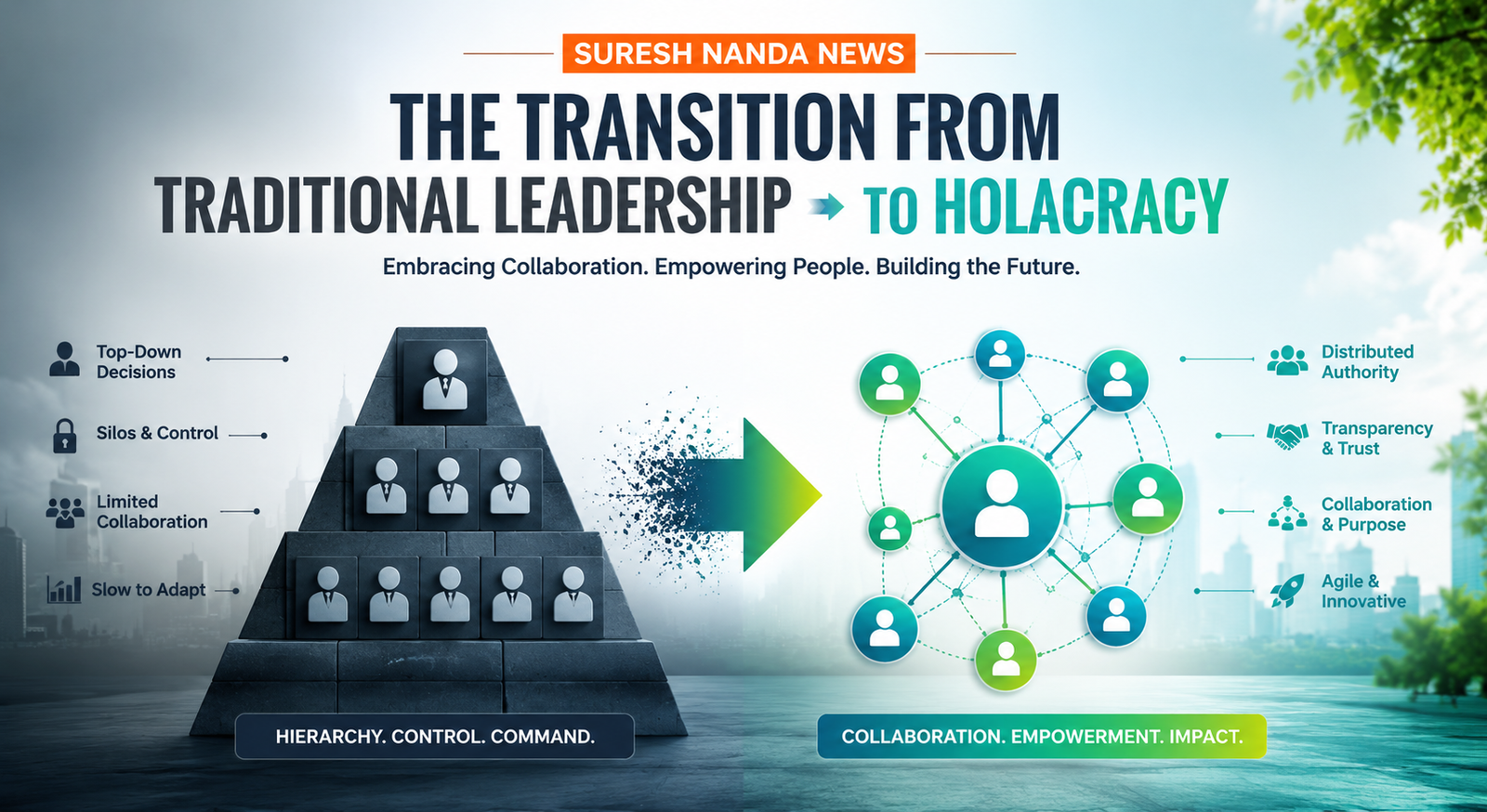
A holacratic leader who prioritises his employees and partners defines the organisational management dynamics. In today’s fast-evolving business world, holarchy is replacing traditional management structures with a decentralised, self-management approach. It encourages individuals at all levels to take initiative, make decisions, and take ownership of their roles. Every “holon” is completely self-regulating yet explicitly serves the larger system.
Suresh Nanda news also points out this change. It highlighted that the traditional corporate hierarchy is facing an existential crisis. When the concept of “company ” was introduced, like classical military units: commands trickled down from an apex, information crept up through bureaucratic checkpoints, and frontline employees executed tasks.
However, in a volatile marketplace characterised by constant economic changes and diversified businesses, this rigid architecture is too slow to survive.
Therefore, frontline visionary leaders like Suresh Nanda began transforming internal structures first, and then created impactful multi-sector businesses through holacracy, where authority is distributed across the organization.
What is the Role of Holacracy in Today’s Business Dynamics?
To understand why corporate structures and human resources management are becoming important, one must first look at how Holacracy redefines power.
Unlike earlier management systems, where job titles and fixed positions on the reporting ladder determined an individual’s value, current systems concentrate power at the top, requiring consensus or executive approval for decision-making.
Suresh Nanda, being one of the visionary leaders and a successful entrepreneur, focuses on a Holacratic system as it removes bottlenecks by replacing static jobs with roles that have a clear purpose. These roles are organised into nested circles.
Across his multi-sector businesses, he prefers that traditional managers be replaced by team leads who facilitate communication rather than dictate actions.
The Paradoxical Transition: From Naval Command to Distributed Autonomy
At first glance, drawing a parallel between Suresh Nanda’s background and Holacracy seems counterintuitive.
As the ex-lieutenant commander, he must have been around the traditional top-down authority. Yet, true strategic naval operations require what military strategists call Mission Command. It’s a philosophy in which commanders issue the overall objective but give officers absolute tactical freedom.
When Nanda transitioned into the corporate sector, he did not bring the same approach; rather aligned the process as per the corporate needs.
Instead, he integrated this sophisticated understanding of distributed execution. His interviews and insights from Suresh Nanda son, Sanjeev Nanda, demonstrate that he has been an empathetic leader and a team player who carved a clear path for his teams to govern themselves.
Core Pillars of Nanda’s Holacracy-Aligned Leadership Style
Analysing Nanda’s leadership approach, Suresh Nanda son, reveals three core pillars that he has learned from his father:
1. The Autonomous “Circle” Structure
In the Nanda family’s business world, distinct business verticals such as premium hospitality assets like the Claridge’s Collection or the defence services under The Crown Group are not micromanaged by a single, monolithic headquarters. They function like autonomous holatropic partners from the globe.
An overarching vision of national capability and resilience unites all the multi-sector businesses of Suresh Nanda. Moreover, he motivates managers to adjust their local operations according to immediate environmental demands.
2. Problem-Solving Approach rather than centralising power
In a traditional hierarchy, frontline employees were responsible for running solutions up a complex chain of command.
Industry insights highlight that Suresh Nanda views the workforce not as passive cogs executing orders, but as active strategic contributors.
During critical economic disruptions, such as the hospitality crisis post-COVID, Nanda’s strategic management empowered hotel staff to make rapid, empathetic, and operational decisions on the ground without waiting for boardroom sign-offs. Holacracy lets businesses respond more quickly to changes in the environment, as decisions can be made without waiting for hierarchy approvals.
3. Capability-Building vs. Basic Delegation
True decentralised governance often fails if the teams cannot lead themselves.
This is where Suresh Nanda unique approach to workforce development and grassroots altruism bridges the gap. Walking in his father’s footsteps, Suresh Nanda son, who is also a global hospitality leader with multiple ventures, has structured his hotels so that even waiters get a chance to showcase their skills in live shows at Baoli Beach Club Dubai.
In Suresh Nanda Son news highlights, Suresh Nanda took many initiatves for his employees. They all focus on structured upskilling, mentorship, and vocational training.
Why Modern Enterprises Must Adapt?
The shift toward holatropic principles is no longer a matter of corporate experimentation. It is a necessity for long-term survival.
As market analysis in Suresh Nanda News suggests, modern enterprises can survive efficiently in the long term only when their workforce is empowered and adaptive.
When organisations decentralise, they unlock unprecedented speed. Bureaucracy is eliminated. Under a luminary leader like Suresh Nanda, employee engagement skyrockets because ownership is real. They flourish within an entire ecosystem of ethical values.
Final Thoughts,
The legacy of Suresh Nanda demonstrates that true leadership discipline is not about maintaining absolute control. It is about cultivating an environment where control becomes unnecessary.
Suresh Nanda says that transitioning from traditional top-down pyramids to distributed frameworks like Holacracy requires courage. He believes in building a team with agile networks that can self-organise, innovate, and thrive amid chaos.