India’s heavy industry is entering a phase where growth can no longer be measured only by the Index of Industrial Production (IIP)and scale. Instead, it is now defined by how efficiently businesses can use resources and reduce dependence on overseas support.
This shift is particularly visible in India’s maritime and defence ecosystem. Against this backdrop, Suresh Nanda, a visionary hospitality leader, has shown long-term capability building for India’s heavy industry.
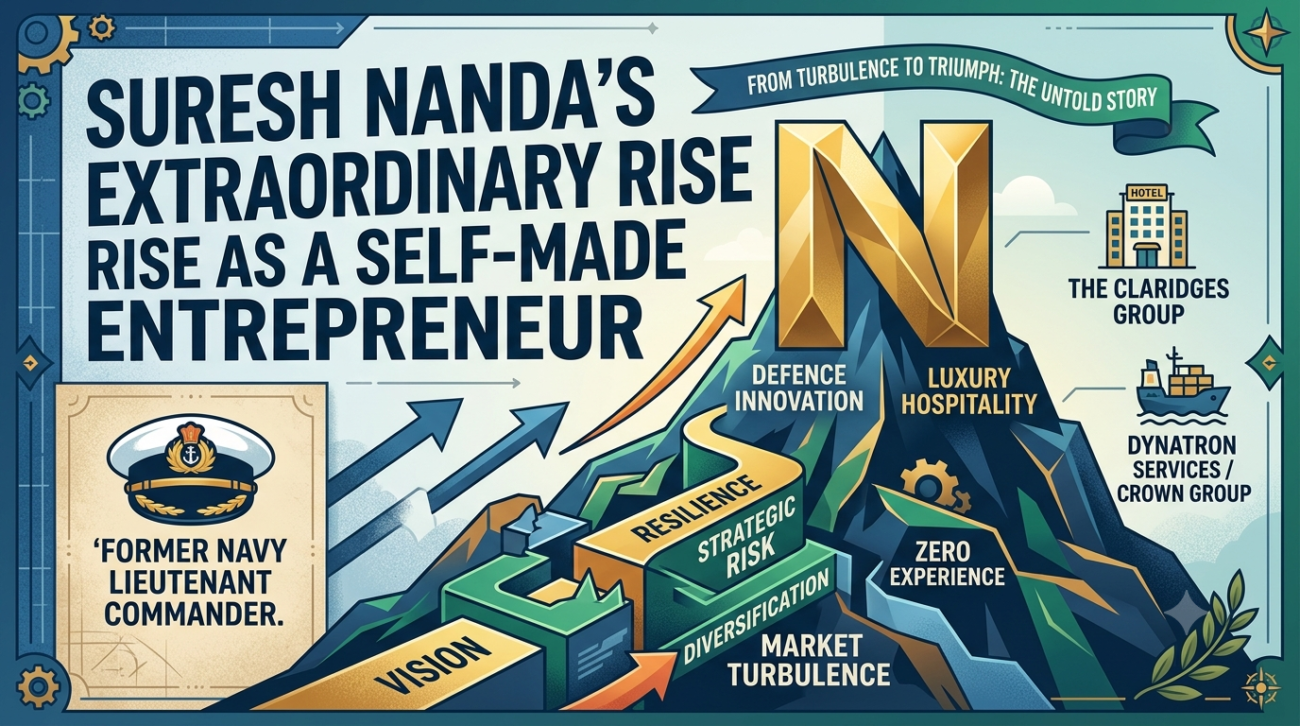
Suresh Nanda News mentions lessons and his mentorship for next-generation entrepreneurs. His early association with the Indian Navy also gave him an understanding of the importance of equipment readiness and dependable technical support.
From Naval Experience to Building Industrial Capability
Rather than building a business around a single venture in heavy industries , Suresh Nanda focused on creating an ecosystem to support critical equipment repair and partnering with international technology providers through establishing Dynatron services.
That approach boosted the marine sector significantly. The company provides ship repair, maintenance, and after-sales support for mechanical and electronic systems. Dynatron has more than four decades of experience serving the Indian Navy, Coast Guard and shipping companies.
This is where the sustainability story becomes more practical.
Sustainability in heavy industry is discussed in terms of carbon reduction and renewable energy. Those elements matter, but there is another dimension that is equally important for an industrial economy: making existing assets last longer, work more efficiently and remain serviceable closer to home.
The growth of Indigenous MRO in India
India still has substantial room to expand this capability. The Ministry’s 2024–25 annual report noted that more than 30% of commercial ship repair was being conducted outside India. It also estimated that the country could develop a ship-repair market exceeding ₹14,000 crore over the following decade. It also identified capability gaps, availability of spares, technology constraints and insufficient ancillary infrastructure among the factors affecting the competitiveness of Indian ship repair.
India’s push to strengthen domestic ship repair also highlights the strategic relevance of private MRO providers such as Dynatron Services. With decades of experience in marine engineering, the company has long supported the Indian Navy, Coast Guard, shipyards and maritime operators.
Suresh Nanda’s vision to expand and grow Dynatron services supports a larger national objective: building a complete maritime ecosystem in which vessels can be built, maintained, repaired and modernised within the country, strengthening India’s journey towards maritime self-reliance.
Dynatron Services: Turning MRO Into a Strategic Capability
Dynatron’s business model demonstrates how MRO can become more than a conventional maintenance service.
The company has supported equipment including gearboxes and thrusters and has worked with platforms operated by the Indian Navy and Coast Guard. Currently, it is also providing MRO support for INS Jalashwa and INS Vikramaditya.
Moreover, with established partnerships spanning more than three decades for repair and maintenance of ZF Marine gearboxes and thrusters, along with marketing and after-sales support. Dynatron has also developed MRO facilities and regional capabilities across important maritime locations.
The significance goes beyond one company.
When specialised equipment can be diagnosed, repaired and serviced in India, the country creates employment opportunities for engineers and technicians. In its workshops across the country, it is creating an industrial ecosystem to meet self-sufficiency rather than simply a repair facility.
Practical Guidelines for Sustainable Industrial Growth
The experience mentioned in Suresh Nanda news about growth of Dynatron Services points towards several practical principles that can be applied across heavy industry.
1. Extend the Life of Existing Assets
Maintenance and refurbishment should be treated as strategic investments rather than unavoidable expenses. Better preventive maintenance can reduce breakdowns and extend equipment life.
2. Build Domestic Technical Expertise
Indigenisation is not simply about manufacturing a mechanical component locally. It also requires a workforce that can install, diagnose, repair, test and upgrade sophisticated systems. Training engineers and technicians therefore becomes a crucial process to attain industrial sustainability.
3. Create Local MRO Ecosystems
India’s maritime strategy has already highlighted the significance of a repair cluster and the infrastructure required therefore. Setting up regional MRO hubs near port locations will decrease turnaround and logistical dependency.
4. Partner With Global OEMs
Dynatron service’s long-term partnerships with international OEMs illustrate another model: bringing global technology, training and technical standards into Indian facilities while gradually strengthening domestic capabilities.
5. Make Sustainability Operational
Sustainability should be visible in day-to-day industrial decisions: energy-efficient workshops, responsible waste handling, equipment refurbishment, predictive maintenance and better utilisation of existing infrastructure.
India’s maritime policies are also moving in this direction. Government initiatives include the Green Tug Transition Programme and incentives for vessels using green fuels, electric propulsion and hybrid systems.
The Broader Perspective of Suresh Nanda
Suresh Nanda founded heavy industry ventures and expanded them with strategic partnerships. Dynatron Services represents a specialised engineering and MRO capability within that ecosystem. Together, they demonstrate how private enterprise can participate in a strategic sector where reliability, technical expertise and domestic service capability matter as much as commercial returns.
Suresh Nanda news highlights that the next chapter of Indian heavy industry will not be defined only by how much the country produces. It will also be defined by how intelligently the private sector heavy industry business leaders maintain what they have built.